For years, the debate about hybrid work has been driven by opinion and anecdote. Executives insist people need to be in the office. Employees insist they get more done at home. Neither side has had much data to back them up.
A study published in Nature changed that. It is the first randomized control trial of hybrid work among knowledge workers, and the results are clear: two days at home, three days in the office, zero measurable cost to performance, and a one-third reduction in attrition.
The Trip.com Experiment
Trip.com, the Chinese travel technology company with roughly 35,000 employees, ran a six-month randomized control trial from August 2021 to January 2022. The setup was simple. Employees in the Airfare and IT divisions were split by birthday. Odd-number birthdays got the option to work from home on Wednesdays and Fridays. Even-number birthdays stayed in the office full-time. Same people, same jobs, same managers. Only the schedule changed.
The sample was 1,612 employees across engineering, marketing, accounting, and finance. These are knowledge workers, not call-center staff. They write code, manage campaigns, and close books. The findings apply to the exact population that most hybrid policies target.
Attrition Dropped by a Third
The headline finding: attrition fell from 7.2% in the control group to 4.8% in the hybrid group. That is a 33% reduction in quit rates, statistically significant at P = 0.043.
Job satisfaction scores rose in parallel. On a 0-to-10 scale, the hybrid group reported higher work-life balance, higher life satisfaction, and a lower intention to quit. The control group, working five days in the office, reported none of those gains.
The retention effect was not uniform. Three groups saw the largest reductions:
- Non-managers: 40% reduction in quit rates. Managers saw no significant change.
- Women: 54% reduction in quit rates. Men saw an insignificant 16% reduction.
- Long commuters: 52% reduction for employees with a two-way commute exceeding 90 minutes.
These are the employees hybrid work was supposed to help. The data confirms it does.
Performance Stayed Flat
This is the finding that should quiet every executive who has argued against hybrid work. Performance reviews, conducted every six months over a two-year period, showed no difference between the hybrid and full-office groups. Promotion rates were identical across both groups.
The researchers also tracked lines of code written by 653 software engineers. No difference. Nine subcategories of performance, including innovation, leadership, and execution, showed no difference.
Zero. Not a small positive. Not a small negative. No difference.
Managers Were Wrong Before the Experiment. Right After It.
Before the experiment, managers expected hybrid work to reduce productivity by 2.6%. Non-managers expected a 0.7% gain. That 3.3-percentage-point gap was significant at P < 0.001.
After six months of actually doing it, manager expectations flipped to +1.0%. They converged with non-managers, who sat at +1.6%. The gap disappeared.
This is the part that should make every CEO uncomfortable. The people running teams had a negative bias against hybrid work that the data did not support. The people doing the work had a more accurate read from the start.
The Business Case
Trip.com executive committee saw the data and rolled out hybrid work to all employees immediately after the experiment ended. Their logic was straightforward: each quit costs approximately $20,000 in recruitment and training. A one-third reduction in attrition across 35,000 employees generates millions in savings.
The math is not complicated. The study estimates that replacing a graduate-level employee costs about 50% of that person annual salary. If hybrid work cuts your quit rate by a third and costs you nothing in performance, the return is obvious.
Why This Matters Now
The study was conducted in Shanghai with a Chinese company. The researchers note, reasonably, that the findings may not transfer perfectly to every context. But Trip.com is a global, NASDAQ-listed multinational with modern offices that look like offices in any major city. The work hours, the job types, and the team structure are familiar.
The finding that hybrid work is a retention tool, not a productivity risk, has been building across smaller studies for years. This is the first time it has been tested at scale with randomization. The result is consistent with everything that came before it.
How Atteniv Can Help
The study proves hybrid work reduces attrition. It does not prove hybrid work is easy to manage. The organizations that succeed with hybrid are the ones that build systems around it. The ones that fail leave it to individual managers and hope for the best.
Atteniv brings structure to that process:
Presence Detection Options
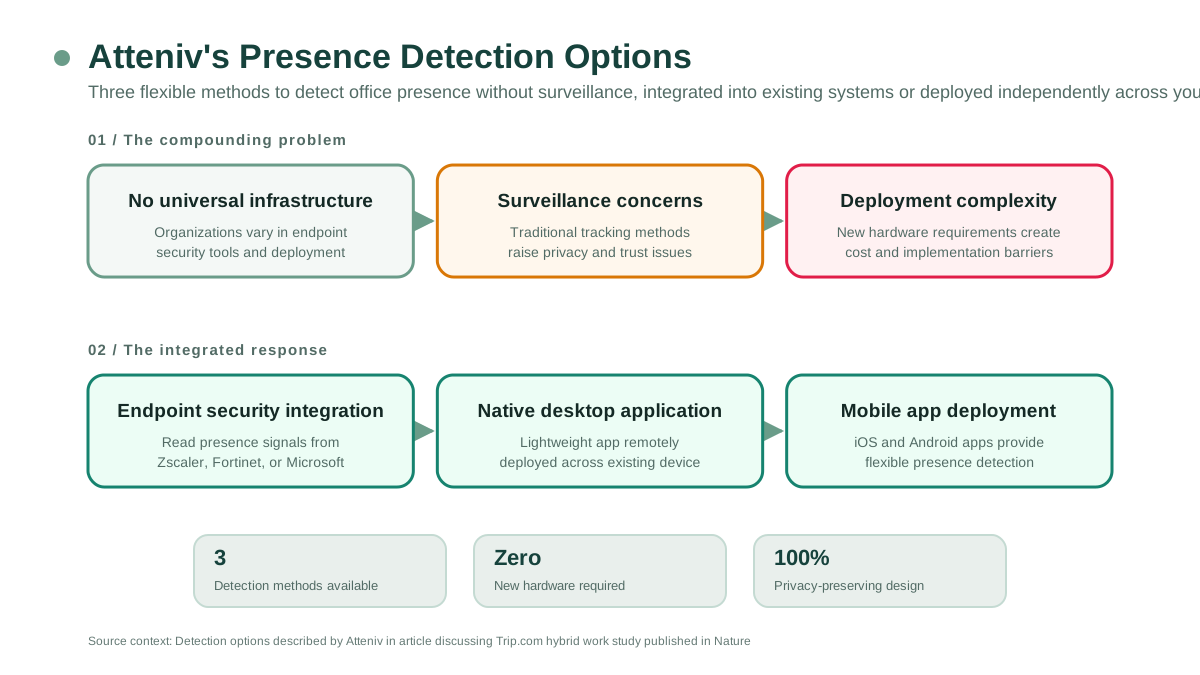
Atteniv reads presence signals from your existing endpoint security tools (Zscaler, Fortinet, Microsoft Defender) so you can detect office presence without new hardware or surveillance. But not every organization has the same infrastructure. Atteniv also offers a lightweight native desktop application that can be remotely deployed across your fleet, as well as a mobile app for iOS and Android devices. You choose the detection method that fits your environment. The system knows who is in the office and who is not, without watching anyone.
Hybrid Scheduling That Coordinates Teams
The Trip.com study used a fixed two-day schedule. Most organizations need something more flexible. Atteniv manages hybrid schedules across teams, departments, and locations so the right people are in the office on the right days. Employees see when their team is in, book what they need, and show up when it matters.
Compliance Automation That Protects You Legally
If you have a hybrid policy, you need to enforce it consistently. Atteniv automates attendance policy enforcement and progressive discipline documentation so the same policy gets applied the same way every time. Every action is logged in an audit-defendable system of record.
Real-Time Office Utilization Analytics
The study found that long commuters were the most likely to quit without hybrid work. Your office utilization data tells you which locations are worth keeping and which are paying for empty space. Atteniv gives you that data in real time, not in an annual survey.
Atteniv Intelligence
Ask plain-language questions about your workforce and get answers grounded in your actual data. "What is the average attendance rate for all offices?" is a question you should not need a spreadsheet to answer.
The infrastructure for hybrid work was never built. Atteniv builds it. Work anywhere, compliant everywhere.