Atteniv launches a public Q&A service that helps HR, payroll, and finance teams understand how all 50 states and DC tax remote and nonresident employees — for single states or complex multi-state situations.
DENVER, CO — July 2026 — Atteniv today launched Nexus Vision, a free, publicly available intelligence service that gives payroll and HR professionals grounded, citation-backed answers to one of the hardest questions in the hybrid-work era: how each U.S. state taxes the wages of remote and nonresident employees. Nexus Vision is available now on the web and via an API for integrators.
As distributed and hybrid workforces have become the norm, employers increasingly face withholding and sourcing questions that span multiple states at once — and getting them wrong can create unexpected liabilities. Nexus Vision is designed to make that landscape navigable, covering how states handle income-tax withholding, how nonresident wages are sourced (including "convenience of the employer" rules), reciprocity agreements, de-minimis thresholds and grace periods, and local or city wage taxes across all 50 states and the District of Columbia.
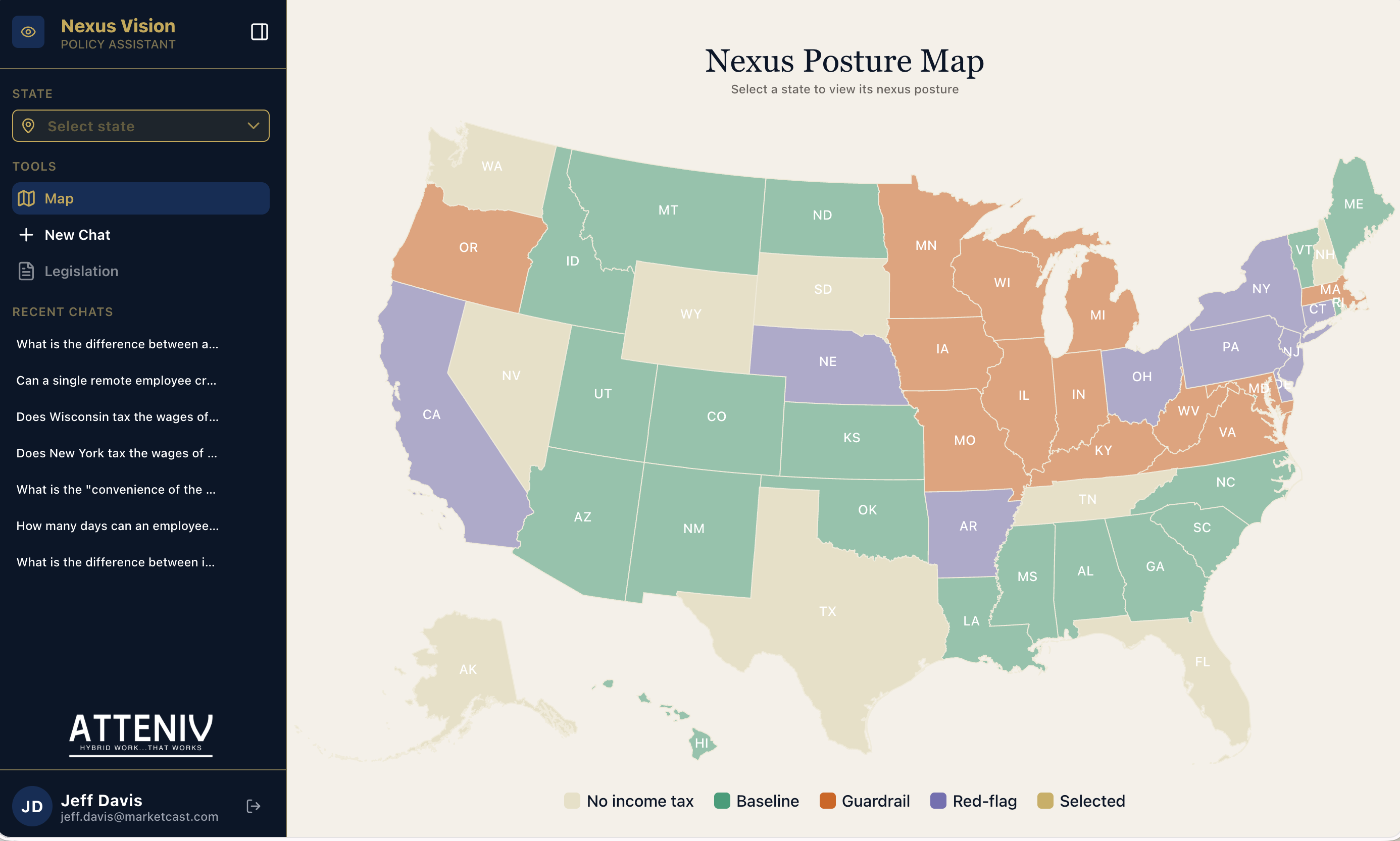
Nexus Vision posture map showing color-coded US states by tax complexity — no income tax, baseline, guardrail, and red-flag categories
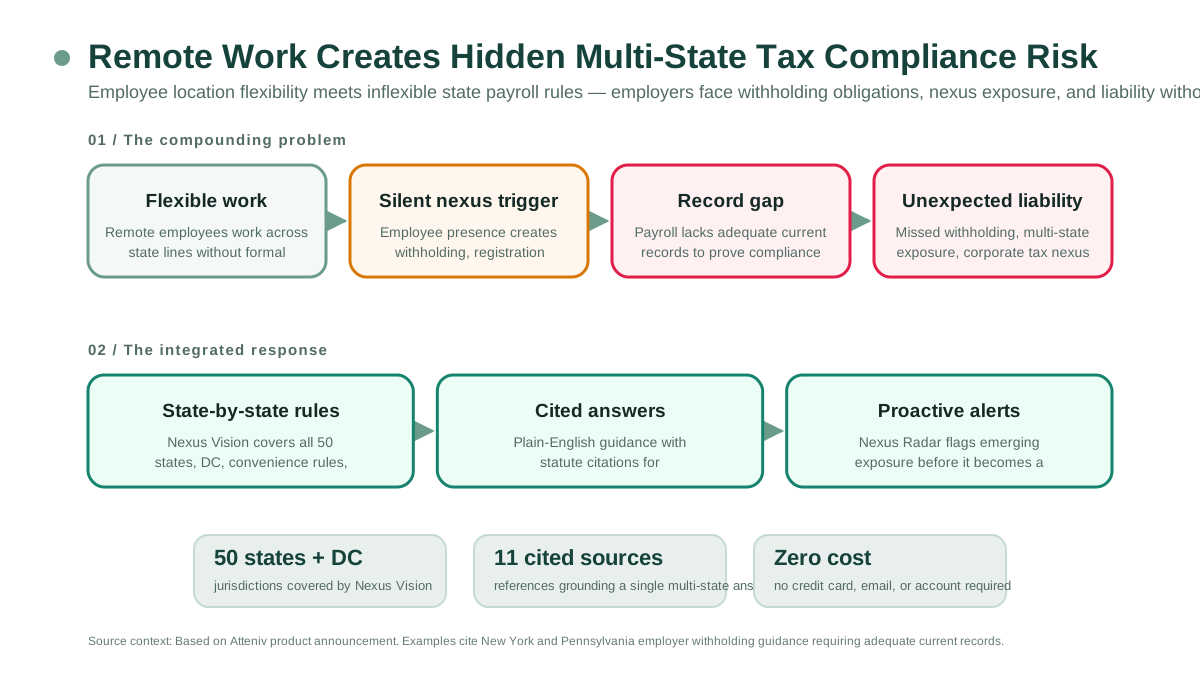
The Problem: Remote Work Made Tax Nexus Everyone's Problem
A remote employee moves from Illinois to Colorado. A sales leader spends the summer working from a family home in New Jersey. A finance employee is assigned to a New York office but works most days from another state. A manager approves a temporary relocation in Slack, but payroll never sees it.
None of these moments looks like a tax event. That is the problem.
Remote and hybrid work made employee location flexible. State payroll, withholding, and nexus rules did not become simple because work became flexible. For employers, the hard question is no longer just "Where does this employee live?" It is "Where did work actually happen, which state rules apply, and can we prove what we knew at the time?"
Tax nexus is the connection that gives a state the authority to impose tax obligations on a business. For employers with remote and hybrid teams, employee presence can be one of the facts that matters. A company may not have an office, warehouse, or storefront in a state. But if an employee works there, even temporarily, the company may need to ask whether that presence creates payroll, withholding, registration, unemployment insurance, workers compensation, corporate income tax, or sales tax obligations.
This is not one national rule. It is a state-by-state problem.
The Convenience Rule Problem
Some states apply what is commonly called a convenience of the employer rule. In plain English, that rule can treat certain remote days as taxable by the employer's state when the employee is working elsewhere for personal convenience rather than employer necessity.
New York, for example, says employers that maintain an office or transact business in New York generally must withhold personal income tax, and that withholding can apply to nonresidents paid wages for services performed in the state. Pennsylvania gives another example of why this gets operationally difficult: its guidance says employers must withhold Pennsylvania personal income tax from nonresident employees for services performed in Pennsylvania, and that employers need adequate current records to determine the accurate amount of Pennsylvania-source compensation.
That last phrase is the part companies miss: adequate current records. A payroll team cannot maintain adequate records if the company does not know where employees are actually working.
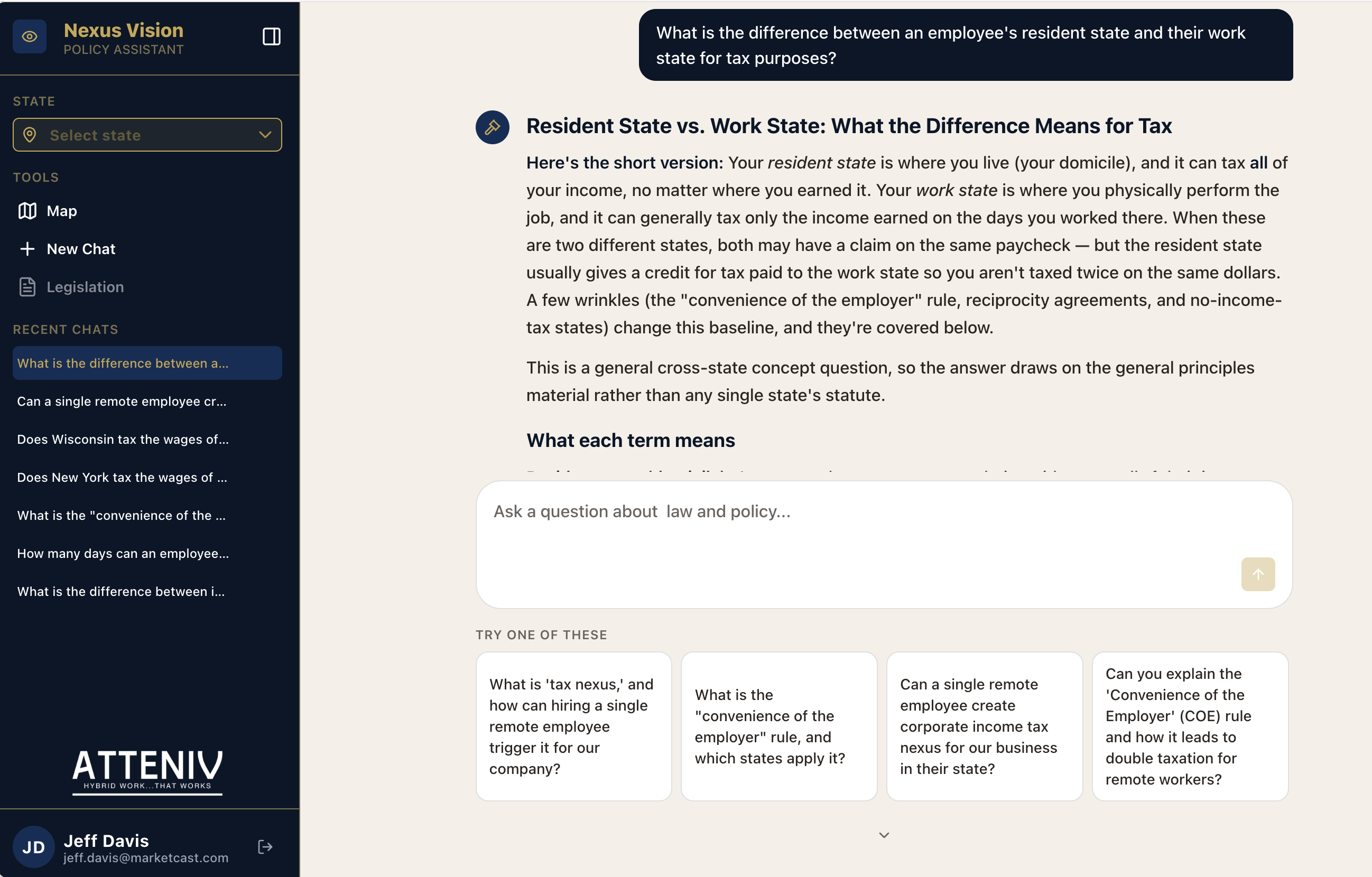
Nexus Vision chat interface answering a question about resident state vs. work state tax differences
What Nexus Vision Does
Unlike a static FAQ or a search engine, Nexus Vision answers real situations. A user can ask about a single state or describe a scenario in plain language — for example, a Colorado company whose employee works remotely from Colorado but spends three months a year in California. Nexus Vision identifies the states involved and returns a single, synthesized answer that reasons across each state's rules plus the general cross-state principles that tie them together — residency, credit for taxes paid to another state, day-based sourcing, and reciprocity — with citations to the underlying statutes so users can verify every point.
For each covered jurisdiction, Nexus Vision provides:
- Linked statute and guidance views — see the underlying law, with key provisions tagged to topics like payroll withholding, employer registration, convenience-of-the-employer, mobile workforce, and more.
- Plain-English summaries — concise explanations of what a rule means operationally (e.g., "how New York treats a part-year resident employee" or "when a remote worker creates NY-source income"), written specifically for HR and payroll audiences.
- Natural-language Q&A over the corpus — ask questions in plain English and get a grounded answer that cites the exact sections it's relying on.
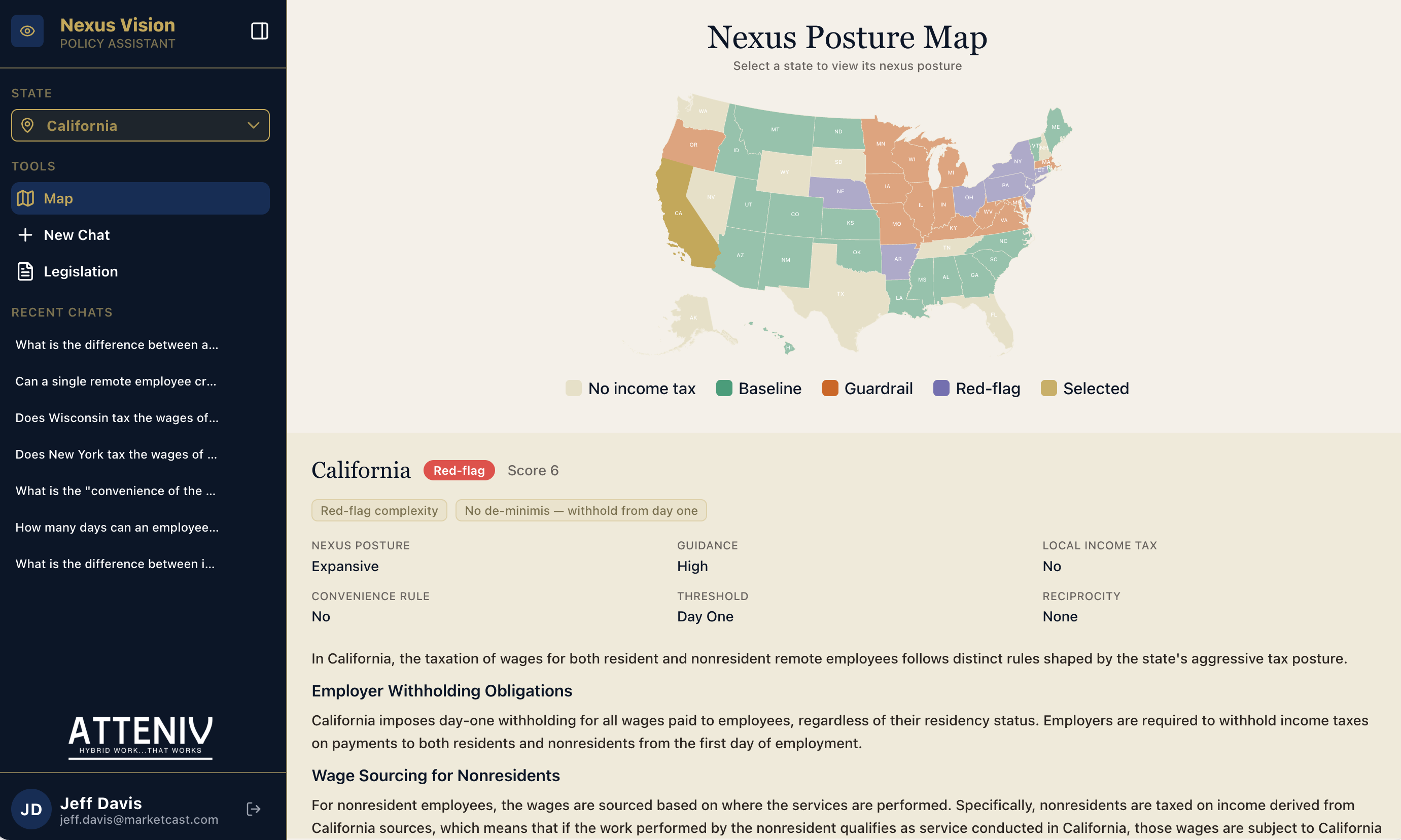
Nexus Vision California state profile showing nexus posture, withholding obligations, and wage sourcing rules
Questions Nexus Vision Answers
Nexus Vision is built around the questions HR, payroll, and finance teams actually ask. These are the same queries that send people into hours of statute research or expensive advisory calls:
- What is a nonresident individual for income tax purposes?
- What is an employer required to do when withholding tax from wages?
- What counts as New York-source income for a nonresident?
- If a New York employer pays a remote employee who lives in another state, when is New York withholding required?
- What is the "convenience of the employer" rule, and which states apply it?
- What happens when an employee works partly inside and partly outside a state during the year?
- How many days can an employee work in another state before triggering nexus?
- What is the employer's liability if withholding was missed?
- Can a single remote employee create corporate income tax nexus for our business in their state?
- How do local taxes, credits, and nonresident earnings taxes fit into the picture?
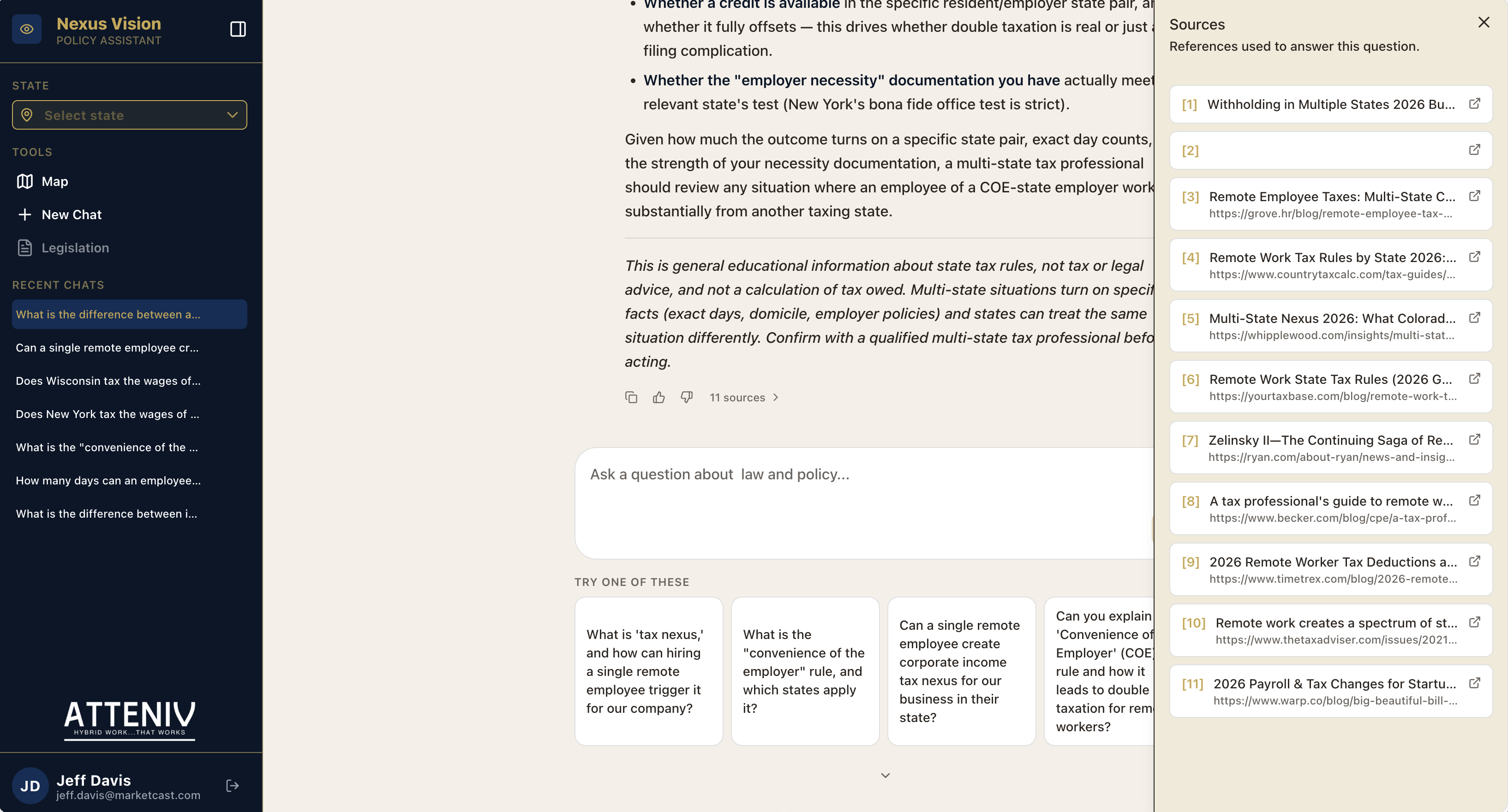
Nexus Vision answer with sources panel showing 11 cited references used to ground the response
Who It's For
Nexus Vision is designed for:
- Payroll managers and specialists dealing with multi-state withholding, SUI, and registrations
- HR and People Ops teams supporting employee moves, remote hires, and hybrid policies
- Controllers and finance leaders who need to understand exposure and know when to loop in outside advisors
- Compliance directors responsible for multi-state regulatory risk
If you're the person who gets tagged whenever someone says, "Can we hire this person in another state?" Nexus Vision is for you.
"Payroll and HR teams shouldn't need a multi-state tax specialist on call just to answer where to withhold for an employee who works across state lines," said Heidi Brown, Chief Marketing Officer and Interim CEO of Atteniv. "Nexus Vision gives them a clear, cited starting point in seconds — grounded in the actual state rules, and honest about where a situation calls for professional advice."
From Answers to Alerts: Nexus Radar
The same nexus knowledge corpus that powers Nexus Vision also drives Nexus Radar, a capability inside Atteniv's flagship hybrid-workforce management platform. Nexus Radar acts as an early-warning system: it combines Atteniv's presence tracking — where employees actually work, day to day — with this nexus knowledge to proactively flag potential tax exposure that teams might otherwise miss.
For instance, when an employee reported in one state begins accumulating taxable days in another, Nexus Radar can surface the emerging liability before it becomes a problem, giving HR and payroll time to act.
Nexus Vision is the free, public research layer. Nexus Radar is the proactive, paid platform feature that connects presence data to nexus risk. Together, they give teams both the knowledge and the early warning they need.
API and Developer Access
Nexus Vision is also available via a public REST API and a Model Context Protocol (MCP) endpoint for teams that want to bring the same answers into their own tools and workflows. The API provides read and ask access for browsing state legislation, asking tax-nexus questions, and managing chat conversations.
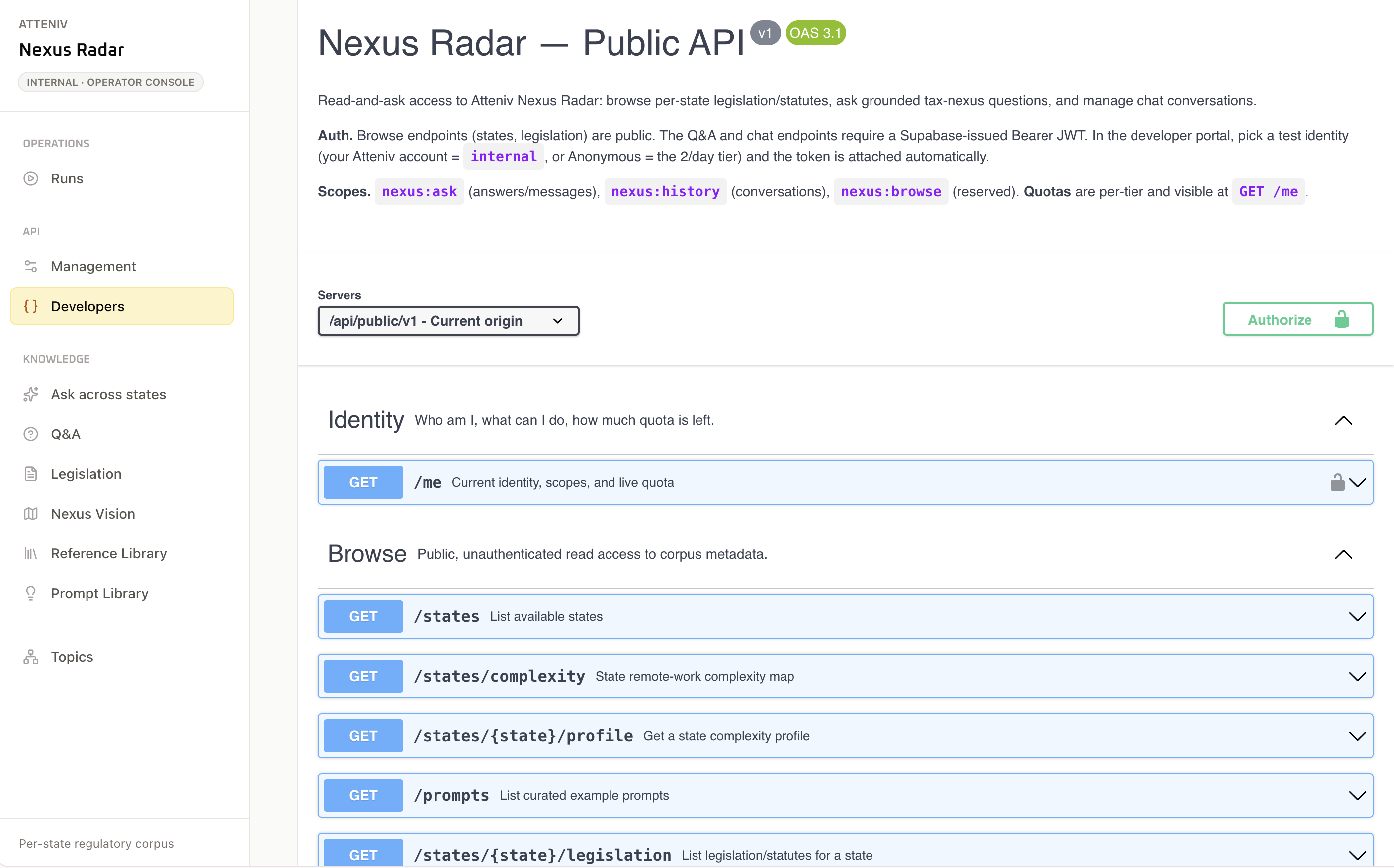
Nexus Radar API documentation showing OpenAPI 3.1 specification with public browse and authenticated Q&A endpoints
Try Nexus Vision
Nexus Vision is available today at atteniv.com. It is fully open access — no credit card, no business email requirement, no account creation, no onboarding. Anyone can use it immediately.
If you're responsible for payroll or HR and you're dealing with remote employees, hybrid policies, or cross-border moves, we'd love your feedback. Your real-world questions will directly shape which states and topics we tackle next.
About Atteniv
Atteniv builds hybrid-workforce management software that helps organizations understand and manage where and how their people work. Its platform combines employee presence tracking with regulatory intelligence — including Nexus Radar, an early-warning system for multi-state remote-work tax exposure — to help HR and payroll teams stay ahead of compliance risk in a distributed-work world. Learn more at atteniv.com.
Nexus Vision provides informational guidance grounded in publicly available state tax authorities and is not a substitute for professional tax or legal advice.