A new study from Robin and the Collab Collective puts a number on something every HR and operations leader already feels: hybrid work creates friction that nobody budgeted for. The average mid-sized company is losing $9 million a year to it. Per employee, the drag reaches $14,000 annually.
The study, published in July 2026, surveyed more than 500 employees and workplace operations professionals across the U.S. and Canada. It introduced something called the Workplace Friction Index, a benchmark for measuring the coordination challenges employees face in hybrid offices. The findings are worth paying attention to, not because they are surprising, but because they quantify a problem that has been treated as an unavoidable cost of flexibility.
What "Workplace Friction" Actually Means
The researchers defined workplace friction as the everyday logistical drag of hybrid work. Finding an available conference room. Coordinating which days your team is in the office. Navigating scheduling conflicts across time zones. Managing desk bookings. Dealing with AV issues in rooms that were designed for a different era of work.
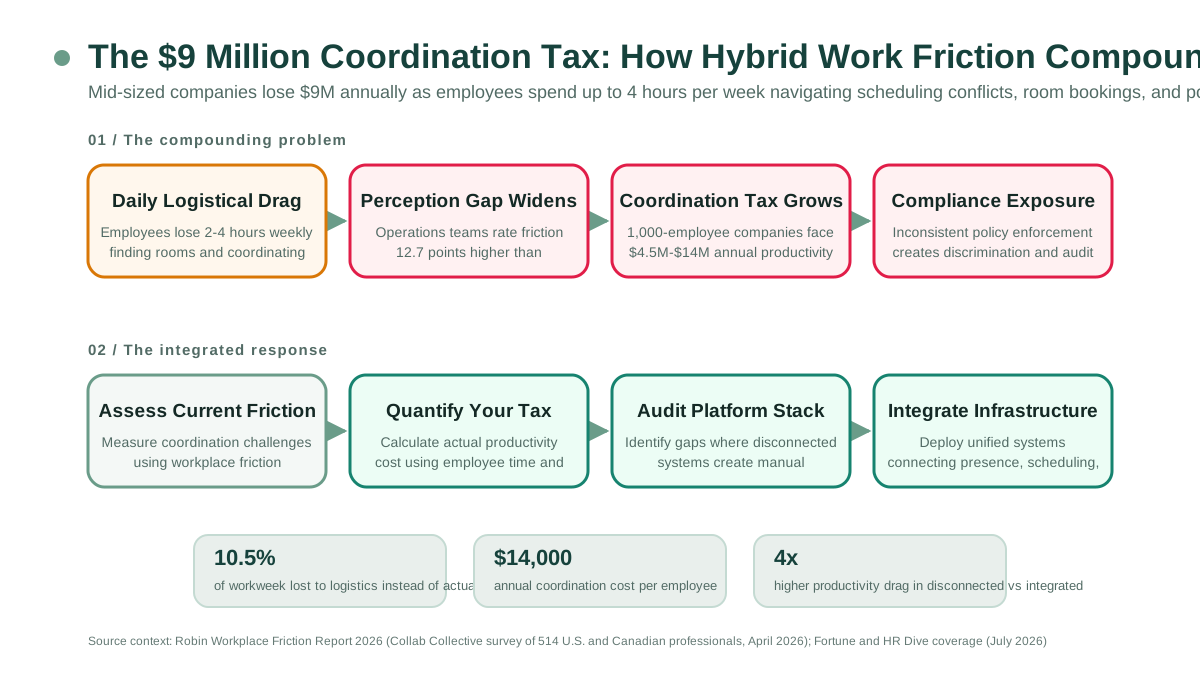
Employees reported losing about two hours per week to these activities. Workplace operations professionals estimated the real number was closer to four hours per week per employee. That gap is itself a finding. The people running the offices see the problem as larger than the people experiencing it, which means the true cost is likely higher than what employees self-report.
Translated into productivity: employees are losing up to 10.5% of their workweek to workplace logistics instead of the work itself. Nearly half of employees (47%) said this friction is a significant drag on their day-to-day productivity. Among the most disconnected offices, that number rises to 63%.
The Coordination Tax Compounds
Here is where the numbers get uncomfortable for finance leaders.
The study calculated an "annual coordination tax" using two variables: employee estimates of time spent on coordination and U.S. Bureau of Labor Statistics compensation benchmarks. For a 1,000-employee organization, the conservative end-user estimate puts the cost at $4.5 million per year. Using the workplace operations estimate, it doubles to $9 million. Apply the BLS knowledge-worker rate, and the figure reaches $14 million per year.
For context, a 100-employee organization is looking at $1.4 million annually in hidden coordination costs. That is not a rounding error. It is a line item that does not appear on any budget because it is distributed across hundreds of small, daily interruptions that never get tracked.
Sixty percent of workplace operations professionals said the problem has increased over the past year. Only 12% said it had declined. The friction is getting worse, not better, as more companies implement hybrid policies without the infrastructure to support them.
The Perception Gap
One of the most revealing findings is the gap between how workplace operations teams and employees experience the problem. Operations professionals rated workplace friction 12.7 points higher on the Workplace Friction Index than employees did. Craig Durr, chief analyst and founder of the Collab Collective, framed it precisely: "Workplace operations teams see friction as a systemic problem because they're the ones fielding the escalations. Employees just experience it as one more frustrating moment in their day."
That mismatch matters. If employees do not perceive the full cost of the friction they experience, they will not report it as a problem. If operations teams see it as systemic but cannot get leadership to fund solutions because employees are not complaining loudly enough, the problem persists. It is the kind of organizational blind spot that compounds quietly until it shows up in an engagement survey or a real estate audit.
The study also found that in the most disconnected offices, 63% of employees say friction is a noticeable drag on productivity. In the most integrated offices, only 14% say the same. Employees in disconnected offices are more than four times as likely to report a productivity drag. The difference is not the policy. It is the execution.
Why This Is a Compliance Problem, Not Just a Productivity Problem
The coordination tax is usually framed as a productivity issue. It is also a compliance issue, and that framing is more useful for HR and finance leaders who need to justify investment in solutions.
When hybrid schedules are uncoordinated, attendance policy enforcement becomes inconsistent. The same policy gets applied differently across teams and managers. Some managers enforce office-day requirements strictly. Others do not. Some employees show up on their scheduled days. Others do not, and nobody notices because the system for tracking presence was never built.
That inconsistency is not just inefficient. It is legal exposure. Inconsistent policy application creates discrimination risk. It undermines ADA and FMLA accommodation tracking. It makes it impossible to produce an audit-defendable record of who was in the office and when.
The Robin study focuses on the productivity cost of friction. But the same coordination failures that cost $9 million in lost time also create the conditions for compliance failures that can cost significantly more in a single audit or lawsuit.
What Reduces Friction
The research points to a clear pattern. Organizations with integrated workplace systems, where scheduling, presence detection, and policy enforcement work together, see dramatically lower friction scores. Organizations relying on disconnected point solutions, manual tracking, and manager-enforced norms see the highest.
The study's authors recommend five steps: assess your current friction level, quantify the tax for your organization, audit your platform stack, evaluate unified workplace platform approaches, and build a business case for investment.
That is sound advice. The missing piece in most organizations is not another booking tool or another survey. It is a system that connects presence data to policy enforcement, so that coordination happens automatically rather than through a chain of Slack messages and calendar negotiations.
The Infrastructure Gap
The Fortune coverage of the Robin study made an observation that aligns with how we think about this problem at Atteniv. The findings suggest that hybrid work creates coordination problems that neither fully remote nor fully in-office models have to solve in the same way. Organizations are better off committing to one model than straddling both, and if they insist on straddling both, they should arm their employees with the operational tools to do so.
The infrastructure for hybrid work was never built. Companies adopted hybrid policies, but they did not build the systems to enforce those policies consistently, coordinate office presence intelligently, or track compliance in a way that holds up under scrutiny. The $9 million coordination tax is what happens when you have a policy without a platform.
The organizations that will win in hybrid work are not the ones with the strictest mandates or the most flexible policies. They are the ones that build the infrastructure to make either approach work. Presence confirmation, not surveillance. Automated coordination, not manual scheduling. Audit-defendable records, not manager discretion.
The coordination tax is real and it is growing. The question is whether you keep paying it, or you build the system that eliminates it.
Sources: Robin Workplace Friction Report 2026 (Collab Collective, April 2026 survey of 514 professionals); Fortune (July 27, 2026); HR Dive (July 30, 2026).