Most companies with return-to-office policies are not enforcing them. They announced a mandate, sent a few reminder emails, and hoped compliance would follow. It did not.
The result is a growing gap between what leadership expects and what employees actually do. Some show up twice a week and call it good. Others badge in, grab coffee, and leave within the hour. Managers know it is happening but have no systematic way to address it. HR is stuck playing catch-up.
This is not a culture problem. It is an operational failure.
The Three Ways RTO Enforcement Breaks Down
1. The Detection Problem
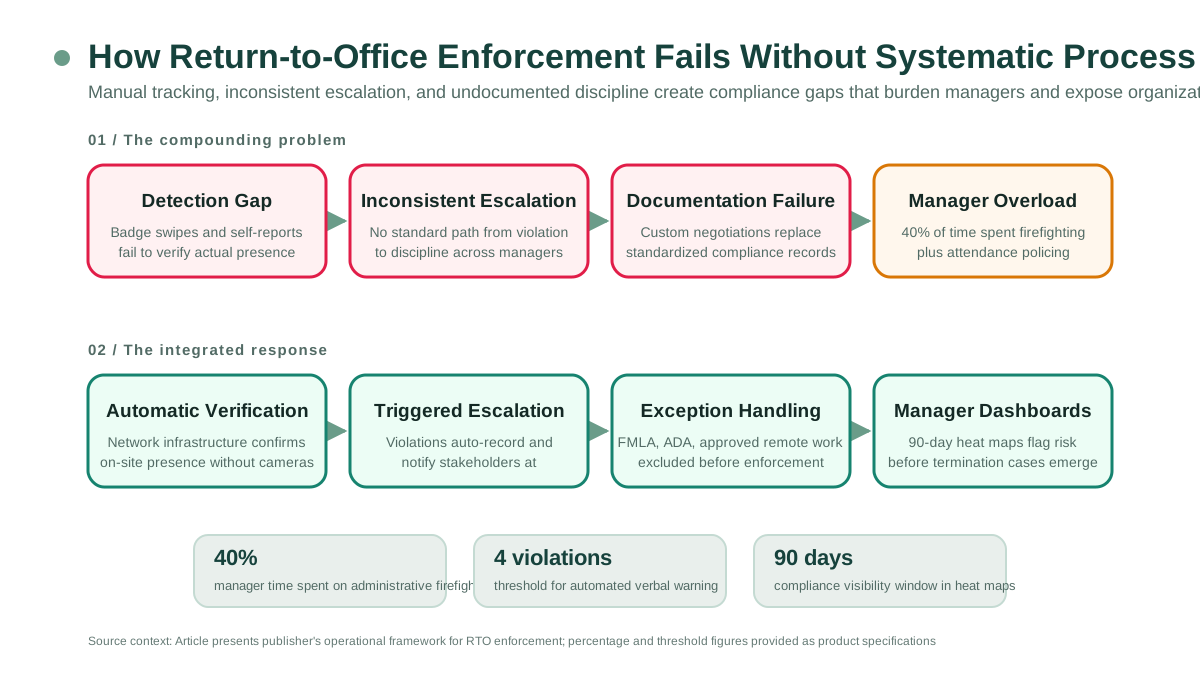
Most organizations rely on badge swipes, self-reported attendance, or manager observation to confirm who is in the office. None of these methods are reliable. Badge data does not tell you if someone stayed. Self-reports are easily gamed. Manager observation does not scale.
Without accurate presence data, enforcement is impossible. You cannot discipline someone for non-compliance if you cannot prove they were not compliant.
2. The Escalation Problem
When a violation is identified, what happens next? In most organizations, the answer depends on who notices, who they tell, and how busy everyone is that week. There is no standardized path from first violation to final warning.
This creates two risks. First, inconsistent enforcement opens the door to legal challenges. If one employee gets a verbal warning at four violations and another does not get one until eight, that is a problem. Second, managers avoid difficult conversations until the situation escalates beyond repair. By the time HR is involved, the pattern is entrenched and the documentation is thin.
3. The Documentation Problem
One of the most overlooked risks in RTO enforcement is the lack of a documented escalation path. When an employee accumulates repeated violations, what happens next? Is there a verbal warning at four occurrences? A written warning at six? Does HR get notified automatically, or does the manager have to remember to loop them in?
Without a standardized process, every case becomes a custom negotiation. That is not compliance. That is improvisation. And improvisation does not hold up in court, in audits, or in front of a union representative.
The other risk is less visible but equally serious: the managers themselves. Middle managers are already spending an estimated 40% of their time on administrative firefighting. Adding attendance policing to their workload burns them out and damages the relationships they need to lead effectively. The goal of an RTO policy is better collaboration, not better resentment.
What Actually Works
Companies that close the compliance gap do three things differently.
First, they verify presence automatically. They do not rely on badge swipes, self-reports, or manager memory. They use existing network infrastructure to confirm that an employee was actually on-site and active during required hours. No cameras. No keystroke logging. Just a lightweight signal that the work happened where it was supposed to.
Second, they automate the escalation path. When a violation occurs, the system records it. When the count hits a threshold, the right person gets notified. When a pattern emerges, HR sees it before it becomes a crisis. The process is consistent, documented, and defensible.
Third, they give managers visibility without burden. A dashboard shows who is compliant, who is at risk, and what the next step is. The manager does not have to be the enforcer. They just have to be the leader.
How Atteniv Closes the Gap
Atteniv is built for exactly this problem. It is not a space-booking tool or a productivity tracker. It is a compliance automation and risk management platform that handles the full lifecycle of attendance policy enforcement.
Automated progressive discipline. Atteniv tracks violations in real time and triggers the next step automatically. Four violations generates a verbal warning with a five-day manager response deadline. Six triggers a written warning and HR notification. Eight escalates to final warning. Nine initiates termination review. Every step is logged, timestamped, and tied to your business rules. No manager has to guess what comes next.
Exception handling built in. Not every missed day is a violation. Atteniv accommodates approved remote work, FMLA, ADA accommodations, and other exceptions before the enforcement engine acts. Your policy stays consistent without becoming rigid.
Manager dashboards that reduce workload. Instead of hunting through spreadsheets, managers see a 90-day heat map, an org hierarchy tree, and drill-down views by department. At-risk employees are flagged before they become termination cases. HR gets visibility without being buried in one-off emails.
The Bottom Line
Return-to-office policy enforcement is not a culture initiative. It is an operational process. And like any operational process, it fails when it relies on manual effort, inconsistent judgment, and undocumented decisions.
The companies that succeed in 2026 will be the ones that treat compliance as infrastructure. Not a memo. Not a conversation. A system.
If your company has an RTO policy on paper but not in practice, Atteniv can help. See how Atteniv automates attendance compliance from detection to documentation. Message us sales@atteniv.com