Your Hybrid Work Policy Isn't a Schedule. It's a System.
Most tools give you a spreadsheet with names and days. Atteniv gives you the operating system for how your workforce actually works.
When companies roll out a hybrid work policy, the first thing they reach for is a schedule. Monday, Wednesday, Friday -- done. Assign it to everyone, put it in a spreadsheet, and move on.
It works for about two weeks.
Then reality sets in. The sales team needs to be in four days a week because clients walk in. Engineering only needs two. A new VP wants her entire org in on Fridays. Someone gets hired in the middle of the quarter and nobody remembers to tell them the schedule. A manager needs the whole team in next Thursday for a planning session but there's no way to say that without creating a whole new schedule. And when HR decides to change the policy from two days to three, it's an email to 500 people and a prayer that everyone adjusts.
The problem isn't the schedule. The problem is that a schedule is a static artifact, and the way your organization actually works is dynamic, layered, and constantly changing.
That's what we built Atteniv to handle.
The gap between policy and reality
Most workforce management tools treat scheduling as a flat assignment: Employee A is on Schedule B. If they show up, they're compliant. If they don't, they're not. Simple.
But hybrid work policies aren't simple. They're layered. HR sets a baseline. Managers customize it for their teams. Employees want flexibility within those boundaries. And then there are exceptions -- company events, client visits, doctor's appointments, team offsites -- that don't fit neatly into any recurring pattern.
The result? A growing disconnect between what the system says an employee's schedule is and what it actually is on any given day. Compliance data becomes unreliable. Managers lose visibility. And the policy everyone agreed on in a leadership meeting quietly stops being enforced.
Atteniv closes that gap. Not by making scheduling more rigid, but by making the entire system -- policies, schedules, overrides, exceptions, and compliance -- work together as one connected whole.
What this looks like in practice
"Everyone needs to be in at least two days. But my team needs three."
HR sets a company-wide policy: minimum two office days per week. That's the floor. But the head of sales knows her team needs more face time -- clients expect it. She sets a stricter team policy: three days per week, Friday mandatory.
In Atteniv, these policies cascade. The sales team sees three days as their requirement, not two, because the team policy layered on top of the company policy -- and the system enforced that it could only get stricter, not looser. If a director under the sales VP tries to relax the policy to one day, the system catches it and requires the VP's approval.
No spreadsheets. No conflicting emails. The hierarchy defines the rules, and the system enforces them.
"Three days a week, but I don't care which three."
Not every team needs everyone on the same days. A product team might say: "Be in three days a week, make sure one of them is Wednesday for our weekly sync, but the other two are up to you."
Most tools can't express this. You either pick three specific days for everyone (rigid) or you track nothing (no accountability).
Atteniv handles this natively. We call it policy-direct mode. Instead of assigning a fixed weekly schedule, the manager sets constraints -- three days minimum, Wednesday mandatory -- and employees operate freely within those boundaries. The system tracks compliance against the constraints, not against specific days. If you're in Monday, Wednesday, and Friday one week, and Tuesday, Wednesday, Thursday the next, you're compliant both weeks. No need to pre-declare. No unnecessary friction.
And if an employee wants to signal which days they plan to come in -- for desk booking, capacity planning, or just team coordination -- they can. It's optional. A planning tool, not a compliance commitment.
"We just hired someone. What schedule are they on?"
It sounds trivial, but it's one of the most common gaps we see. A new hire joins a team, and nobody remembers to assign them a schedule. For days -- sometimes weeks -- they exist in the system with no attendance obligation, which means no compliance tracking.
In Atteniv, every manager can designate one of their schedules as the team default. When a new hire joins, the system automatically assigns them by walking up the management chain until it finds a default. If your direct manager has one, you get it. If not, it checks your manager's manager. And so on, up to the company-wide default.
Day one, the new hire has a schedule. Day one, compliance tracking starts. Nobody had to remember anything.
"I need everyone in on Thursday this week."
A client is visiting. A quarterly planning session. An offsite that only makes sense in person. Managers deal with these situations constantly, and the answer shouldn't be "create an entirely new schedule and reassign everyone."
Atteniv supports schedule overrides -- lightweight, time-bound modifications that layer on top of whatever schedule is already in place. A manager can say "add Thursday this week for my team" and that's it. The system adds the requirement, tracks compliance against it, and automatically reverts to the regular schedule the following week. No manual cleanup.
Overrides can be additive (add a day) or replacement (swap the entire schedule for a period). And they respect the policy hierarchy -- if an override would result in fewer days than the policy requires, it needs approval from the policy owner before it takes effect. No one accidentally undermines the policy with a well-intentioned override.
"We're going from two days to three, starting April 1."
Policy changes are stressful. They affect everyone, and the usual process is an email announcement followed by weeks of confusion about who needs to adjust and by when.
Atteniv turns this into a managed transition. When HR creates a new version of a policy with a future effective date, the system immediately runs an impact analysis -- identifying every schedule across the organization that will become non-compliant under the new rules.
HR sees the full picture: "45 schedules across 12 teams will be affected." Each manager sees their piece: "6 of your team schedules will need to be updated by April 1." Schedules that will become non-compliant are highlighted in the dashboard with a clear explanation of what changed and what action is needed.
When April 1 arrives, any schedule that hasn't been updated is automatically flagged. No surprises. No "I didn't know." The transition is visible, measurable, and managed.
"I can't make it in on Friday. I have a doctor's appointment."
When a policy says "Friday is mandatory," there will always be legitimate exceptions. The question is whether those exceptions are handled formally or via a Slack message that nobody tracks.
In Atteniv, employees can see exactly which days are required by policy -- and they can request exceptions directly from their schedule view. "I need to work remotely this Friday. Reason: medical appointment." The request routes to their manager for approval. If approved, Friday's requirement is lifted for that date, and the employee's compliance isn't affected.
Every exception is tracked. Every decision is logged. When HR audits compliance six months later, they can see not just who was compliant and who wasn't, but why -- and who approved it.
One system. Full visibility.
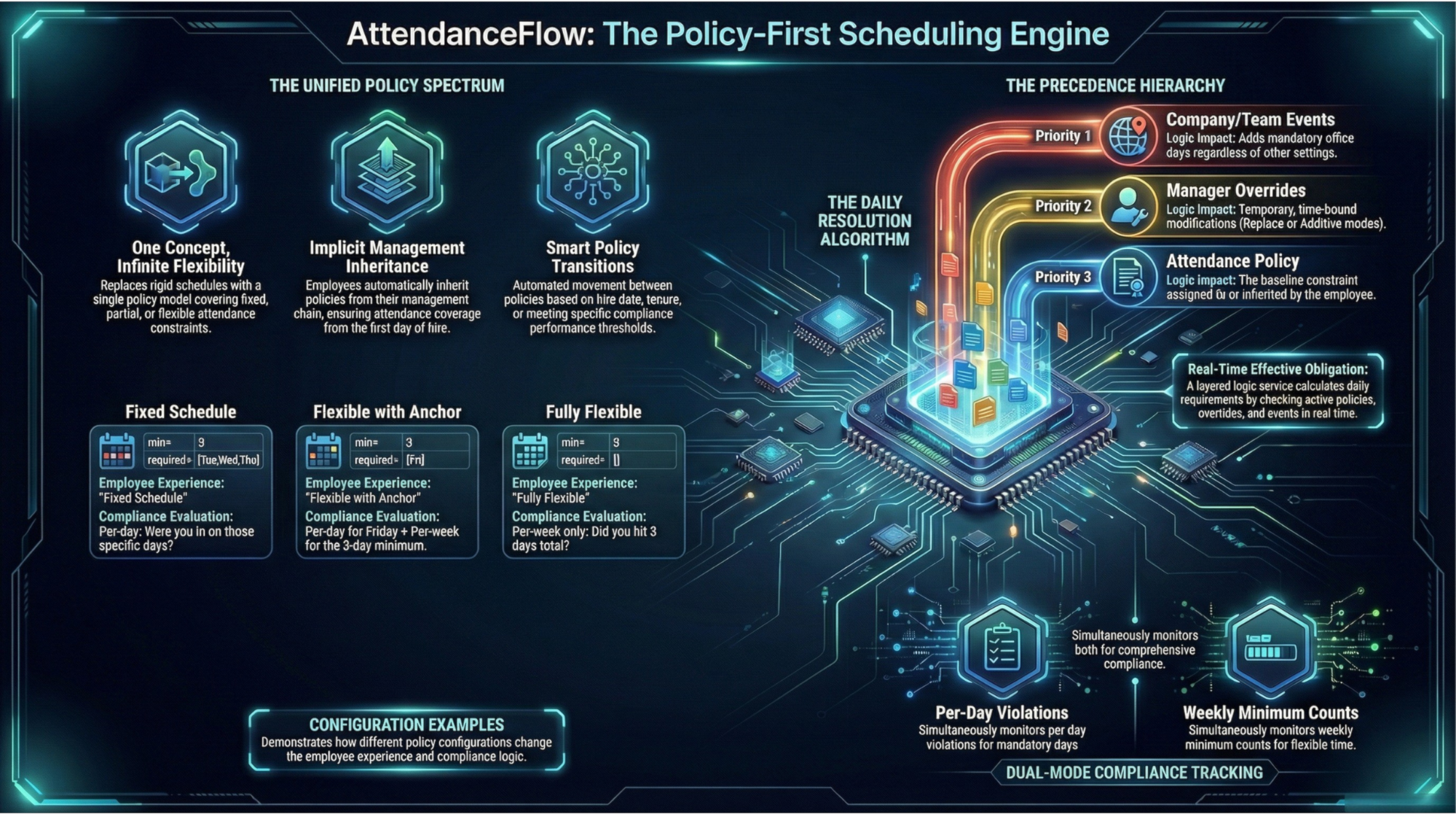
The thread connecting all of these scenarios is that Atteniv doesn't treat scheduling as a standalone feature. It's part of a connected system where policies, schedules, overrides, events, exceptions, and compliance all talk to each other.
When a manager creates a schedule, the system validates it against the applicable policy. When an override adds a day, compliance tracking picks it up. When a policy changes, every affected schedule is identified before the change takes effect. When an employee requests an exception, the approval is logged and the compliance engine accounts for it.
And all of it respects the organizational hierarchy. Managers see their team. VPs see their org. HR sees everything. Nobody sees data they shouldn't.
The result is a system that reflects how your organization actually operates -- not a static schedule that was accurate for two weeks in January.
The bottom line
Hybrid work policies are more than a list of days. They're a set of rules that interact with management hierarchies, team needs, individual flexibility, and real-world exceptions. Most tools give you a checkbox grid and call it scheduling.
Atteniv gives you the infrastructure to define the rules, enforce them consistently, adapt when things change, and know -- with confidence -- whether your organization is actually following through.
If you're outgrowing spreadsheets and finding that your "hybrid policy" is really just a suggestion, we'd love to show you what a real system looks like.